 Albania
 Argentina
 Australia
 Belgia
 Bosnia-Hercegovina
 Brasil
 Bulgaria
 Canada
 Chile
Chile
 Colombia
 Danmark
 Estland
 Filippinene
 Finland
 France
 Hellas
 Irland
 Italia
 Kroatia
 Latvia
 Litauen
 Luxembourg
 Mexico
 Moldova
 Montenegro
 Nederland
 New Zealand
 Nord-Makedonia
 Norge
Norge
 Polen
Polen
 Portugal
 Romania
 Sambandsstatene
 Serbia
 Slovakia
 Slovenia
 Spania
 Storbritannia
 Sveits
 Sverige
 Sør-Afrika
 Tsjekkia
 Tyrkia
 Tyskland
 Ukraina
 Ungarn
 Østerrike







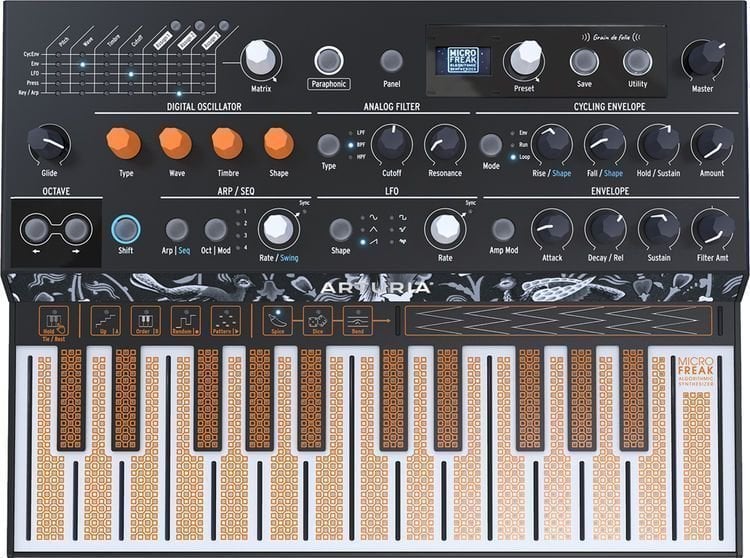




Arturia Microfreak
Arturia MicroFreak er en hybrid maskinvaresynthesizer som kombinerer en digital oscillator med flere algoritmer og et analogt filter i SEM-stil, og spilles via et flatt 25-tangenters kapasitivt PCB-klaviatur med polyfonisk aftertouch. Den rommer 21 oscillatormoduser, en 64-trinns sequencer med fire automasjonsspor og en 5×7 modulasjonsmatrise i et 1,02 kg lett kabinett som får strøm via USB.
- 21 digitale oscillatormoduser som dekker wavetable, Karplus-Strong, virtuell analog, granulær, talesyntese og vocoder
- Analogt 12 dB/oktav tilstandsvariabelt filter inspirert av det klassiske SEM-designet, med selvoscillasjon
- Flatt kapasitivt klaviatur med 25 tangenter og polyfonisk aftertouch for uttrykksfull kontroll på hver enkelt tangent
- 64-trinns sequencer med Spice & Dice-randomizere og fire parameterautomasjonsspor per forhåndsinnstilling
- Kompakt kabinett på 1,02 kg med strømforsyning via USB, samt CV/Gate-, MIDI- og clock-I/O for studio og scene
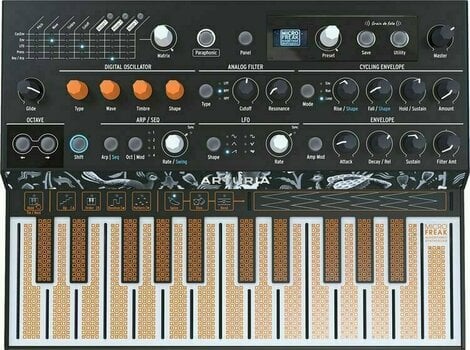
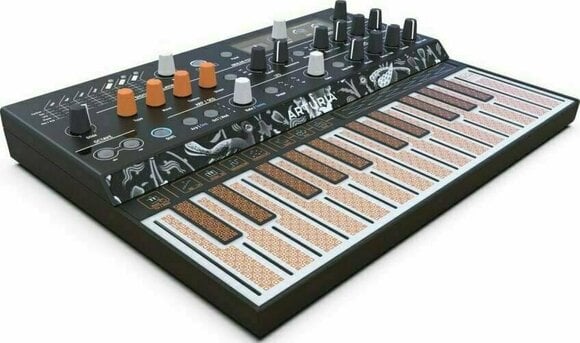
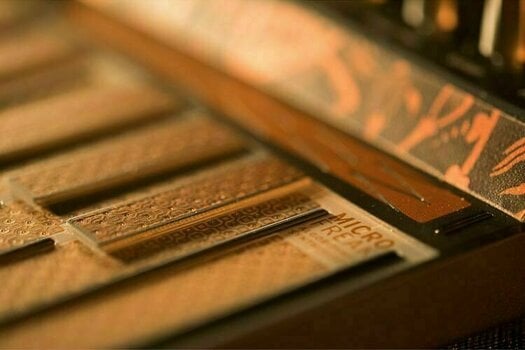
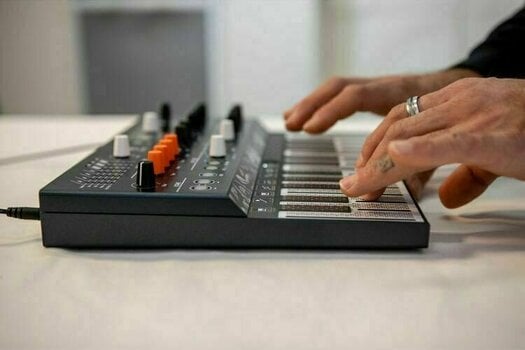
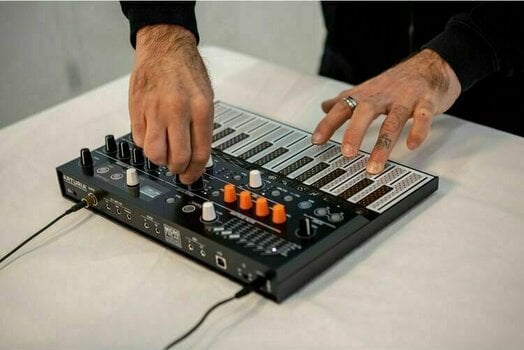
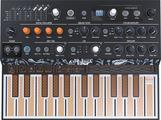
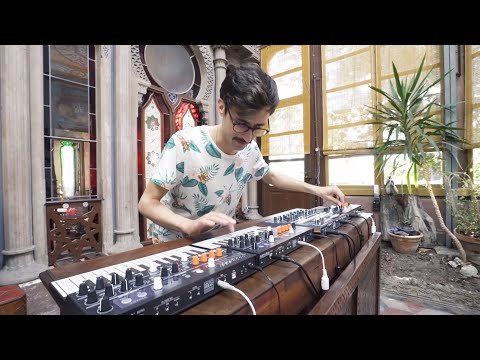
Arturia MicroFreak hybridsynthesizer — et kapasitivt klaviatur med 25 tangenter møter 21 digitale oscillatormoduser
Arturia MicroFreak er en eksperimentell hybridsynthesizer som forener en digital oscillatormotor med flere algoritmer og et ekte analogt filter i SEM-stil, alt styrt av et flatt, kapasitivt kretskort-klaviatur. Denne modellen gir produsenter, lyddesignere og live-artister ett enkelt kompakt instrument som håndterer wavetable, virtuell analog, granulær syntese, fysisk modellering og talesyntese. Med 21 oscillatormoduser, polyfonisk aftertouch og en 64-trinns sequencer leverer denne synthesizeren en uvanlig bred klangpalett i forhold til størrelsen og prisklassen.
Fremtredende funksjoner: kapasitivt klaviatur, hybridmotor og modulasjonsmatrise
Det som skiller enheten fra tradisjonelle maskinvaresynther, er det flate, berøringsfølsomme kapasitive PCB-klaviaturet med 25 tangenter som registrerer både anslagsfølsomhet og polyfonisk aftertouch basert på trykket og berøringsflaten fra fingertuppen. Hybridarkitekturen sender en heldigital oscillator gjennom et 12 dB/oktav analogt tilstandsvariabelt filter inspirert av klassiske Oberheim SEM, med mulighet for lavpass-, båndpass- og høypassdrift samt selvoscillasjon. En modulasjonsmatrise med 5 kilder og 7 destinasjoner samt tre brukerdefinerte rutingmuligheter — i tillegg til Spice- og Dice-randomizere i sequenceren — lar eksperimentelle musikere skape mønstre som kan overraske selv den som programmerer dem.
Oscillatormotor — 21 moduser i ett instrument
Den digitale oscillatoren er synthesizerens kjerne og grunnen til at den kan låte som dusinvis av ulike synthesizere i et enkelt forhåndsinnstilt oppsett. Modusene spenner fra Basic Waves og Virtual Analog til Wavetable, Karplus-Strong fysisk modellering, harmonisk additiv syntese og tre granulære motorer, inkludert sju algoritmer hentet fra Mutable Instruments' Plaits og tre utviklet i samarbeid med Noise Engineering.
- Oscillatormodusene byr på 21 digitale algoritmer som dekker wavetable, virtuell analog, FM, granulær syntese, tale, vokoder og fysisk modellering i én og samme motor.
- Polyfoni: monofonisk, parafonisk eller unison opptil 4 stemmer — omkoblingsbar arkitektur for leads, massive basser eller akkorder med fire toner
- Filter: analogt 12 dB/oktav tilstandsvariabelt LPF/BPF/HPF — SEM-inspirert krets som kan selvoscillere for rå og skarp resonans
Klaviatur og uttrykk — polyfonisk aftertouch på et flatt kretskort
Det kapasitive klaviaturet med 25 tangenter er dens mest markante og uttrykksfulle egenskap. Hver tangent registrerer trykk via fingertuppens kontaktflate, slik at aftertouch-verdien øker når fingeren legges flatere. Dette åpner for modulasjon per tone på en måte tradisjonelle bevegelige tangenter ikke kan matche.
- Antall tangenter: 25 kapasitive PCB-tangenter — flate, robuste og upåvirket av mekanisk slitasje under transport
- Klaviaturtype: berøringsfølsomt kapasitivt klaviatur — registrerer anslagsstyrke fra første berøring
- Aftertouch: polyfonisk — hver av de 25 tangentene kan styre sitt eget modulasjonsmål samtidig
Sequencer, modulasjon og tilkoblinger — bygget for studio og scene
I tillegg til oscillatoren og klaviaturet leveres instrumentet med en omfattende performance-sequencer og et fleksibelt modulasjonssystem som forvandler frontpanelet til en virtuell modulær lekeplass. Sequenceren på 64 trinn lagrer to mønstre per forhåndsinnstilling og fire spor for parameterautomatisering, mens den sykliske konvolutten kan fungere som enten en vanlig envelope eller en ekstra LFO med variable stige- og falltider.
- Sequencer: polyfonisk 64-trinns sequencer med 4 automatiseringsspor — lang nok til fraser på fire hele takter med levende parameterbevegelser
- Envelope: ADSR pluss syklisk envelope — hoved-ADSR former amplituden, mens den sykliske modulatoren fungerer både som envelope og LFO
- LFO: 1 LFO med bølgeformene sinus, trekant, sagtann, firkant, tilfeldig og utjevnet tilfeldig (slew random) — kan synkroniseres til tempoet
- Modulasjon: matrise med 5 kilder × 7 destinasjoner og 3 brukerplasser — koble om signalveien virtuelt helt uten kabler
- Minne for forhåndsinnstillinger: 512 plasser inkludert 320 fabrikkinnstillinger — rikelig med lagringsplass for både standardlyder og egne patches
- Inn-/utganger: USB, MIDI inn/ut, CV/Gate/Pressure, analog klokke inn/ut — integreres sømløst med DAW-er, Eurorack og klassisk maskinvare
- Strømforsyning: USB eller medfølgende strømforsyning — lavspent digital oscillatorteknologi fjerner behovet for en stor og tung strømadapter
Hvem passer den for — produsenter, lyddesignere og live-artister
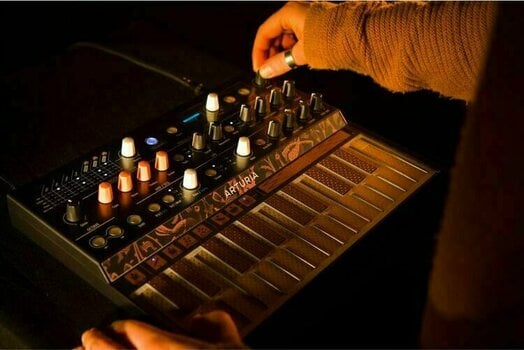
MicroFreak er det rette valget for elektroniske produsenter, lyddesignere og live-artister som ønsker en hybridsynthesizer som sømløst kan skifte mellom wavetable-leads, Karplus-Strong-plukking, granulære teksturer og basser med analog filtrering uten å bytte instrument. Soveromsprodusenter vil ha stor nytte av 64-trinns sequenceren med Spice- og Dice-randomizere, som kan skape utviklende mønstre selv når inspirasjonen svikter. Modulærentusiaster vil sette pris på CV/Gate- og Pressure-utgangene som lar enheten styre Eurorack-moduler, mens klaviaturet med polyfonisk aftertouch gjør den til en kapabel kontroller for programvareinstrumenter i en DAW. Med en vekt på kun 1,02 kg og strømdrift via USB er den enkel å ta med på spillejobber, jamsessions og til studioer der plassen er begrenset.
Merke- og produkthistorie — Arturias hybride opprør
Arturia utviklet dette instrumentet som et bevisst brudd med trenden for analoge monosynther ved å kombinere digitale oscillatoralgoritmer fra Mutable Instruments' åpen kildekode-motor Plaits med et ekte analogt filter i SEM-stil. Instrumentet bærer frasen «Grain de folie» — et snev av galskap — på frontpanelet som et tegn på dets eksperimentelle formål. Siden lanseringen har kontinuerlige fastvareoppdateringer utvidet antall oscillatormoduser fra opprinnelig 12 til 21, med tillegg av sample-avspilling, granulær prosessering og en vokoder.

Тype
Desktop Synthesizer
Aftertouch
LFO
Envelope
ADSR (1 ), Cycling Envelope
Oscillators
Modulation
Arpeggiator
Effect Types
Number of Presets
MIDI Interface
Bluetooth
Sound Engine
Number of Keys
Keyboard Type
Polyphonic Aftertouch, Touch-Sensitive Capacitive Keybed
Key Size
Standard
Polyphony
Pitch Bend
No
Storage Medium
Colour
Headphone Output
Inputs
Pedal Inputs
USB MIDI
USB to Device
USB to Host
Filter
Analog State Variable Filter, 12dB/Octave, Low Pass, High Pass, Band Pass
Sequencer
Yes
UK/EU Power supply included
Width (cm)
31,1
Height (cm)
5,5
Depth (cm)
23,3
Weight
1 kg
Net Weight (kg)
1,02
Made in
China


Alle vurderinger kommer fra verifiserte kunder som har kjøpt et produkt fra oss tidligere.
AI-oppsummering av anmeldelser
Basert på antall vurderinger: 54
Styrker
- Sound versatility: Customers appreciate the wide range of sound possibilities due to its unique oscillator and numerous oscillator types, allowing for extensive sound design and experimentation.
- Portability and size: The synthesizer is noted for its lightweight and compact design, making it easy to transport for live performances or on-the-go music creation.
- Unique keyboard: The non-traditional capacitive keyboard is highlighted as a key feature, offering new sonic possibilities and an engaging physical playing experience.
- Value for money: Many customers consider this synthesizer an excellent investment, offering high quality and extensive features at an affordable price point.
- USB power option: The ability to power the device via USB, including power banks, is a convenient feature that enhances its portability and usability.
Svakheter
- USB connectivity issues: Some users reported occasional problems with USB connectivity on macOS, requiring a device restart to re-establish the connection.
- Lack of built-in effects: The absence of integrated effects is noted as a limitation, though customers suggest it can be easily compensated for with external software or pedals.
Hva kundene gjentar
Konklusjon
Dokumenter
Instruksjoner for bruk
Informasjon fra produsenten
Sikkerhetsinstruksjoner
Se brukerhåndboken for spesifikke sikkerhetsinstruksjoner for dette produktet.


